UK Gambling Licence Checker and Official Register Verification
 Available in US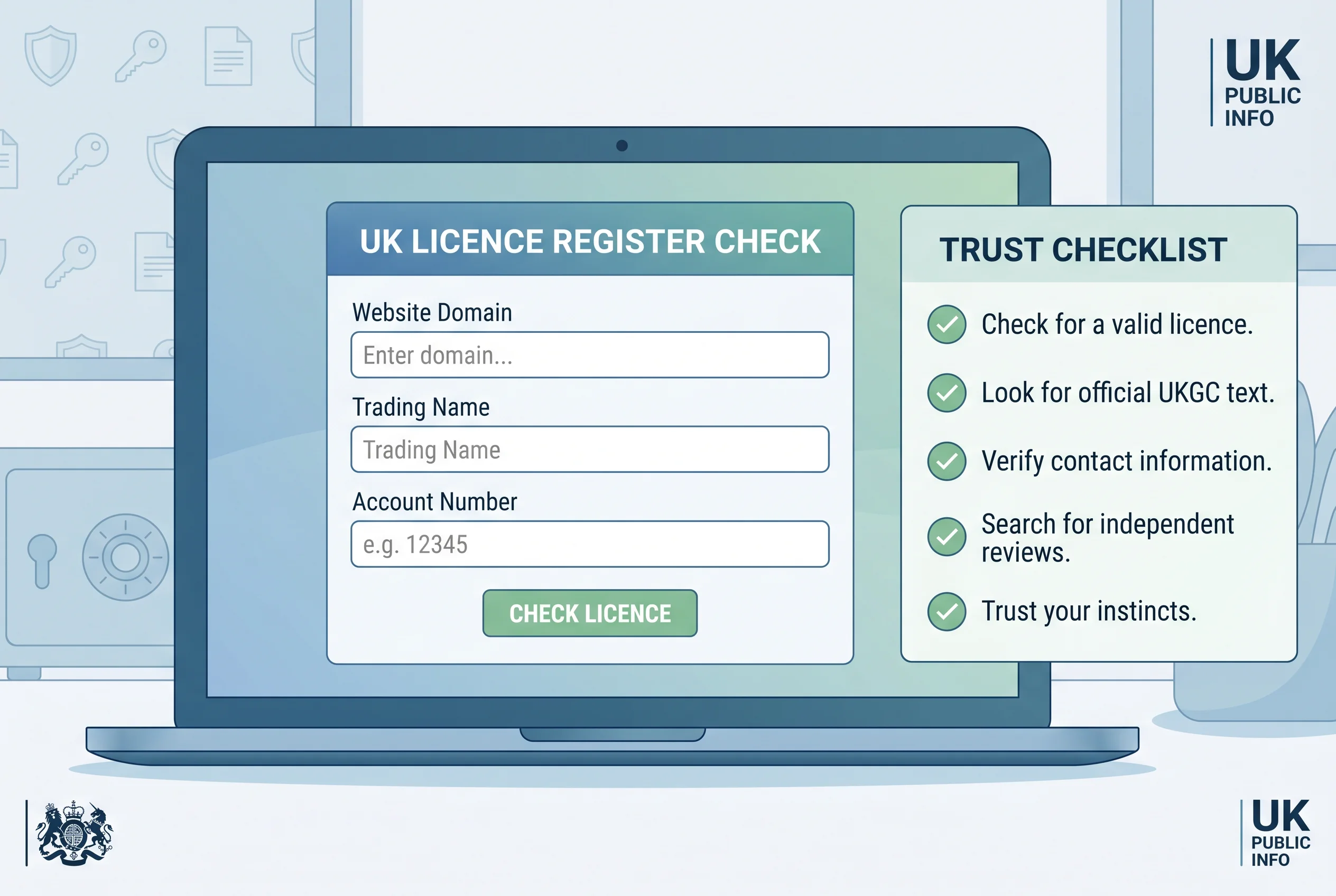
Key License Details to Confirm on the Official Register
The practical question is whether the website, business name, trading name or account number you are seeing is connected with a Gambling Commission licence. The public register can be checked by business name, trading name, domain name or account number. Those details are useful, but they should be read carefully. Domain and trading names are supplied by businesses, and the register is not a promise that every third-party page using similar wording is honest.
A careful check is not the same as a guarantee. It reduces the chance that you rely on an unsupported claim. If the details do not match, if the site hides licence information, or if the account number points somewhere unexpected, the sensible action is to pause. Do not fill the gap with assumptions, forum comments or a marketing explanation from the site itself.
The decision path
- Find the licence statement on the gambling website. Licensed remote operators should display a Gambling Commission statement, an account number and a status link. Look for this information in the footer or legal information area, but do not assume that a badge alone is reliable.
- Copy the exact details. Note the domain name in the address bar, the trading name displayed to customers, the legal business name if shown, and any account number. Small spelling differences can matter.
- Check the official public register. Use the official register rather than a copy on another site. Try the account number first if you have it, then the business name, trading name and domain.
- Compare the result with what you saw. Look for the same business, the same domain or trading name, and the licence status. A similar name is not enough if other details do not line up.
- Pause if anything is missing or inconsistent. A mismatch does not require you to make a legal finding. It is enough reason not to deposit while the position is unclear.
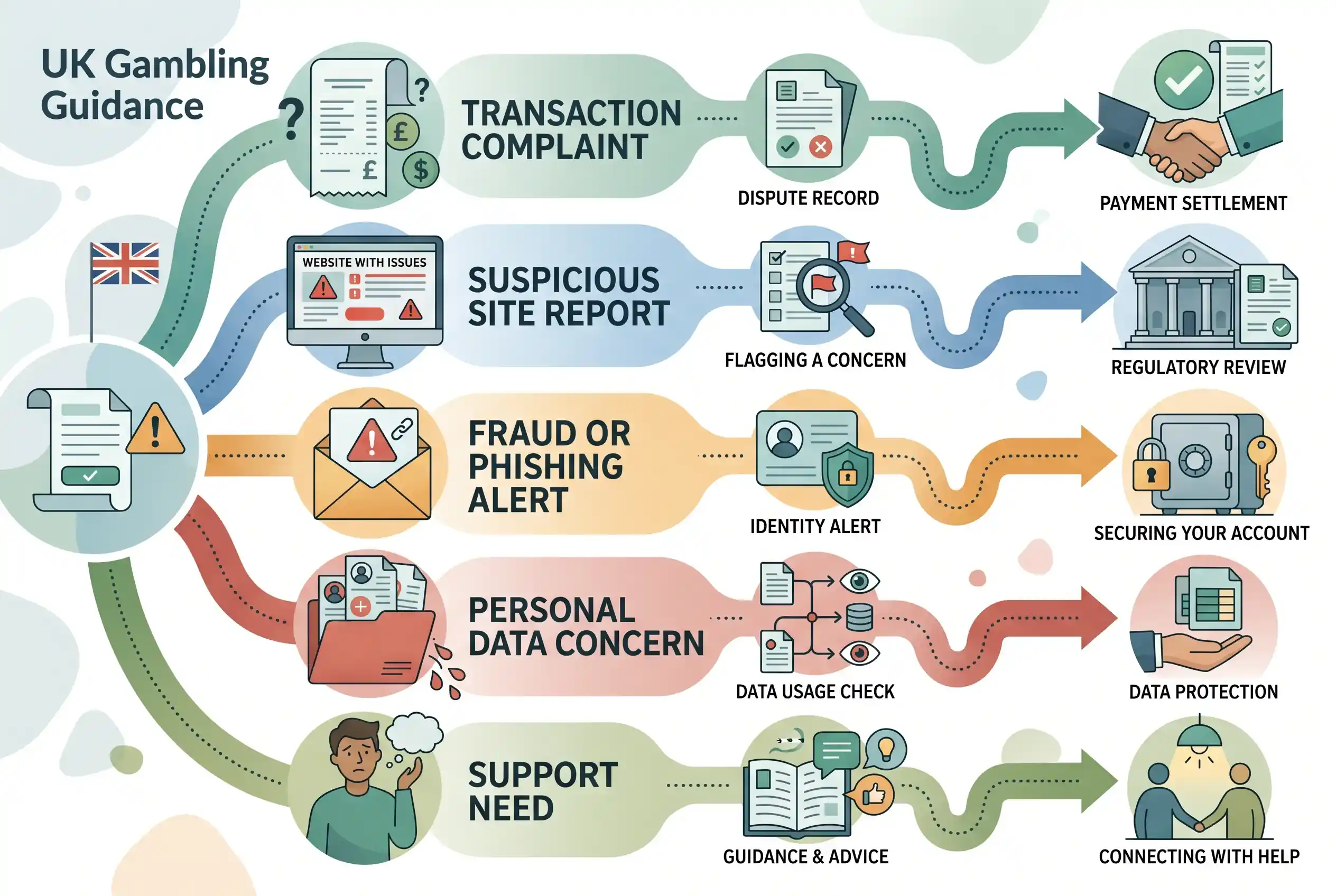
- Use the right route if the site looks suspicious. If you think a site is pretending to be licensed, keep records of what you saw and use the relevant official reporting or complaint route.
What to compare
| Detail to check | Why it matters | How to read a problem |
|---|---|---|
| Domain name | A licensed business may list domains connected with its remote gambling activity. | If the live domain is absent or only looks similar, do not assume it belongs to the same business. |
| Account number | The licensed-status display requirement expects remote operators to show an account number and status link. | If no number is shown, or the number points to an unrelated entry, treat that as a serious pause point. |
| Business name | The legal business behind a gambling site may differ from the customer-facing brand. | A brand-like name without a clear business match should not be treated as confirmation. |
| Trading name | Trading names can help connect the customer-facing name to the register entry. | Because these names are supplied by businesses, they should be checked alongside the domain and account number. |
| Licence status | Status matters because a suspended or inactive position changes what the information means. | Do not rely on an old screenshot, an advert or a copied badge if the official status does not support it. |
Why a foreign licence claim is not enough
Some gambling websites point to a licence, certificate or company registration outside Great Britain. That may describe oversight in another place, but it should not be treated as a substitute for Gambling Commission authorisation where gambling facilities are offered to consumers in Great Britain. The point is not that every overseas reference is fake. The point is that it answers a different question.
If a site is promoted to you because it is outside GAMSTOP, the foreign-licence claim can easily distract from the more important boundary: what official status applies for Great Britain, what protections are available, and what route exists if something goes wrong. A well-presented footer is not the same as an official match.
What a register match can and cannot prove
A matching entry can help confirm that a business has a Gambling Commission licence and that certain details are connected with that entry. It does not prove that every page using a similar name is genuine. It does not prove that a copied logo belongs on the site where you saw it. It does not promise fast withdrawals, fair treatment in every case, or that gambling is a good decision for you.
Think of the register as one essential check, not the whole due-diligence process. You still need to read terms, customer-funds information, complaint routes, privacy information and payment details. You also need to consider your own position. If you are self-excluded, the licensing check is not a reason to search for a way back into gambling. It may be the moment to stop and use support instead.
When the details do not match
Do not let urgency make the decision for you. Sites that push fast deposits, limited-time offers or immediate account creation can make a mismatch feel like a minor technical issue. It is not minor when your money, documents and personal data are involved.
- If the site shows no Gambling Commission account number, pause.
- If the account number leads to a different business or a different domain, pause.
- If the site claims a licence but only links to a foreign authority, do not treat that as confirmation for Great Britain.
- If the support team gives vague answers, screenshots, or a copied certificate instead of clear official details, do not deposit.
- If you already deposited and now have a dispute, keep records and read the complaints and reporting guide before sending more money or documents.
What not to rely on
Do not rely on a review page, a forum post, a bonus banner, a streamer, a private message, or a social-media advert as proof of licence status. These may be wrong, outdated, selective or promotional. Do not rely on the phrase “trusted”, “verified”, “licensed internationally” or “safe for UK players” unless the official details line up. Do not rely on a logo image that does not link to a live official status page.
Also avoid turning the check into a way to shop for weaker controls. If the reason you are checking is that GAMSTOP blocks your usual sites, the issue is not just licence status. It is also whether gambling is becoming difficult to control. In that case, the more useful next page is the support and control guide.
A simple example
Imagine a site footer says it is operated by one company, but the domain in your browser is not listed on the register entry you find. The name looks similar, and the site uses official-looking wording. That is still not enough. The careful response is to stop, compare the account number, check whether the status link is genuine, and avoid depositing until the mismatch is resolved through official information. You do not need to prove bad intent. You only need enough uncertainty to protect your money and data.
Now imagine the site has a clear account number and the register entry appears to match the domain and business. That is better, but it still does not remove every risk. You still need to read terms, withdrawal rules, customer-funds information and complaint routes. Licence checking is the start of a safer decision, not a promise that the decision is right for you.
Even if a platform appears on a register, you must still evaluate the risk signals to notice before depositing your funds.
We strongly advise all players to consult the best independent casino safety portal to ensure a secure gaming environment.
Frequently asked questions
Should I check the register before creating an account?
Yes. It is easier to pause before giving personal data or money than to solve a problem after an account is open.
Is one matching word in the business name enough?
No. Compare several details: account number, domain, trading name, business name and status. Similar wording can be misleading.
Can I rely on a licence logo in the footer?
Not by itself. A logo can be copied. Look for the account number, status link and official register match.
What if I am self-excluded?
Do not use a licence check as a route back into gambling. Use support and blocking tools, especially if you feel pressure to deposit quickly.
Created by the "Casino not on Gamstop" editorial team.